The Science of Readability in 2026 FSSAI Standards
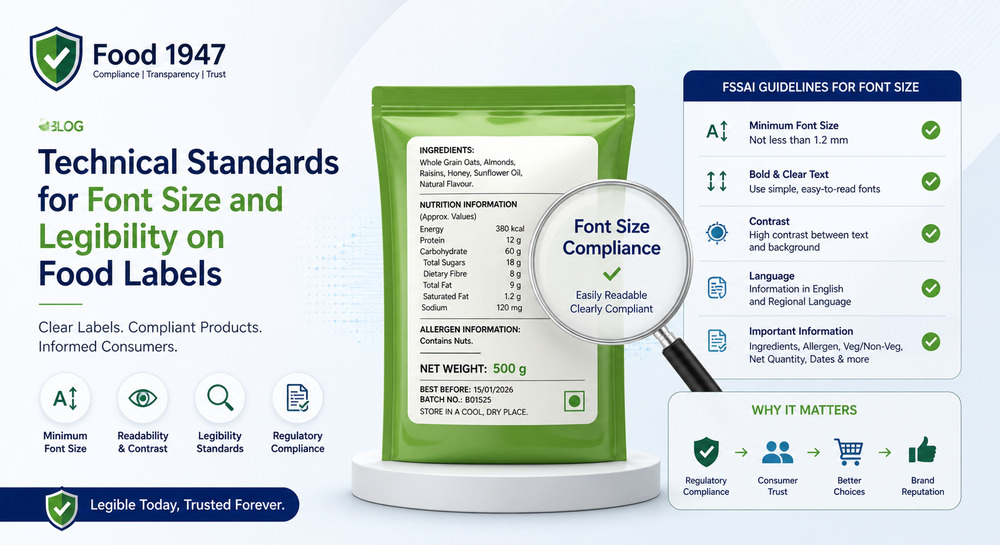
In the 2026 regulatory landscape, legibility is no longer subjective; it is a technical requirement defined by precision. FSSAI has standardized the relationship between the surface area of a package and the minimum font size of the text. This impacts the industry by forcing a redesign of high-density labels, where information was previously "crammed" in tiny fonts. FSSAI’s role is to ensure that the public, including the elderly, can read essential safety information without a magnifying glass. The industry helps business operators by providing typography guidelines that specify x-height and stroke width for maximum clarity. Key stakeholders include packaging designers, regulatory auditors, and font foundries. Compliance in 2026 dictates that the height of numerals and letters must be at least 1 mm for small packs and up to 6 mm for large bulk containers. Industry advice is to use sans-serif fonts like Roboto or Arial, which maintain clarity at smaller sizes. By prioritizing legibility, business operators reduce the risk of consumer errors and regulatory non-compliance during market surveillance.
Contrast and Color: The Visual Mandate for 2026
Beyond size, the 2026 FSSAI amendments focus heavily on color contrast between the text and the background. This impacts the Indian food industry by limiting the use of certain artistic but low-contrast color palettes on labels. FSSAI’s role is to protect the public by ensuring that mandatory declarations—like the list of ingredients and the FSSAI logo—stand out clearly. The industry helps business operators by providing "Contrast Ratio Tools" that ensure compliance before the printing stage. Key stakeholders include brand managers and printing houses. An additional insight for 2026 is that transparent packaging now requires a high-contrast "solid background" behind the text area to ensure readability regardless of the product's color inside. Industry advice is to maintain at least a 4.5:1 contrast ratio for all safety-critical text. Compliance in this area is a primary focus for FSSAI enforcement officers, who now use portable digital colorimeters during inspections.
The Relationship Between Surface Area and Numeral Height
The 2026 FSSAI Labelling and Display regulations utilize a sliding scale for font height based on the principal display panel (PDP) area. This impacts the industry by making the calculation of "available surface area" a critical first step in label design. FSSAI’s role is to provide a clear mathematical framework ($cm^2$ vs $mm$ height) to prevent ambiguity in labeling. The industry helps business operators by automating these calculations through regulatory software. Key stakeholders include R&D teams and packaging engineers. For example, a pack with a surface area up to 100 $cm^2$ requires a minimum height of 1 mm, whereas a pack exceeding 2500 $cm^2$ requires 6 mm. Additional insights for 2026 show that these rules now apply strictly to "Digital Labels" as well. Industry advice is to always "size up" to the next millimeter to account for printing tolerances and avoid technical non-compliance. Correct numeral height is the bedrock of transparent food labeling in the modern Indian market.
Front-of-Pack (FOPL) Legibility and Warnings
The most scrutinized area of font compliance in 2026 is the Front-of-Pack Labelling (FOPL), specifically for high fat, sugar, and salt (HFSS) warnings. This impacts the industry by requiring bold, red-coded symbols that are instantly recognizable. FSSAI’s role is to act as a guardian of public health, ensuring that "danger signs" are not buried in fine print. The industry helps business operators by providing FOPL templates that are pre-configured for the 2026 size requirements. Key stakeholders include health activists, food manufacturers, and the FSSAI scientific panel. An additional insight for 2026 is that the word "Warning" must now be in a font size at least 1.5 times larger than the surrounding text. Industry advice centers on the "two-second rule"—if a consumer cannot read the warning in two seconds from a distance of one meter, the font is too small. Compliance in FOPL is currently the highest priority for the regulator, with zero tolerance for legibility errors.
Mandatory Declaration Placement and Consistency
FSSAI in 2026 has mandated specific "zones" on the label for certain declarations to ensure consistency across the market. This impacts the industry by limiting the creative freedom of designers but significantly improving the user experience for the public. FSSAI’s role is to standardize the Indian marketplace so that consumers always know where to look for the FSSAI license number or the "Best Before" date. The industry helps business operators by establishing "Universal Label Maps" that align with these zoning requirements. Key stakeholders include retail associations and consumer protection groups. An additional insight for 2026 is the requirement that all mandatory text must be oriented in the same direction, preventing the need for consumers to rotate the package multiple times. Industry advice is to group safety-related data (allergens, expiry, storage) in a single "Safety Box" for maximum visibility. Compliance with placement rules is as critical as the font size itself, forming a comprehensive legibility strategy.
Enforcement Trends and Printing Quality Standards
In 2026, the quality of the print is as important as the font size. FSSAI has issued advisories against "smudged" or "fading" ink on labels. This impacts the industry by requiring higher-grade printing consumables and better curing processes. FSSAI’s role is to ensure that the public has access to safety data throughout the product’s entire shelf life. The industry helps business operators by conducting "Rub Tests" and "Fade Resistance" audits on packaging materials. Key stakeholders include ink manufacturers and quality control auditors. An additional insight for 2026 is the use of automated "Vision Systems" on production lines to check for legibility in real-time. Industry advice is to switch to thermal transfer or high-resolution inkjet printing for date marking to prevent illegibility. Compliance is not just about the design but about the durability of the information. A label that becomes unreadable after a month in a warehouse is considered non-compliant, exposing the business operator to penalties.
Defining Quality Through Technical Legibility
In conclusion, technical standards for font size and legibility are the cornerstone of consumer safety in 2026. FSSAI’s rigorous framework ensures that essential information is accessible to everyone, regardless of age or physical ability. For business operators, meeting these standards is an opportunity to demonstrate transparency and build a professional brand image. Compliance in font and contrast is not just a legal hurdle; it is a commitment to the quality and integrity of your product. By seeking professional guidance and prioritizing legibility, you can protect your business from regulatory risks and ensure your products stand out for all the right reasons in the competitive Indian market.