The Digital Food Frontier: E-commerce Labelling in 2026
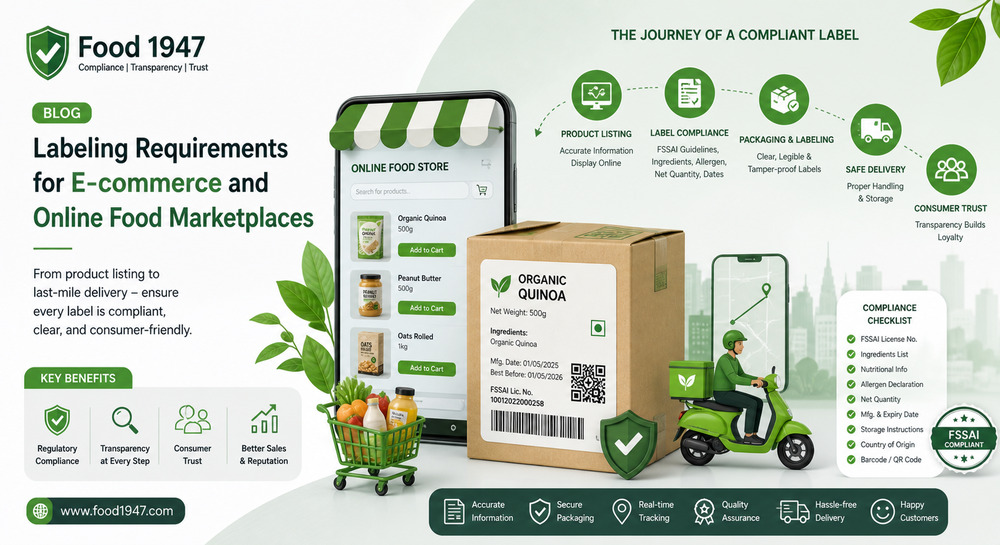
The Indian e-commerce food sector in 2026 has evolved into a highly regulated digital ecosystem, where the "virtual label" is just as important as the physical one. With the massive growth of Quick Commerce and D2C brands, FSSAI has introduced specific mandates to ensure that online consumers have access to all mandatory product information before they click "buy." This impacts the Indian food industry by requiring a perfect synchronization between physical packaging and digital listings, eliminating the "information gap" that once existed in online shopping. FSSAI’s role is to ensure public safety by mandating that high-resolution images of the Principal Display Panel, including ingredients, allergens, and nutritional facts, are visible on all marketplace platforms. The industry helps business operators by providing standardized APIs and digital asset management tools that push compliant data directly to aggregators like Swiggy, Zomato, and BigBasket. Key stakeholders, including e-commerce platform owners, third-party logistics providers, and digital marketing agencies, are now legally bound to uphold these transparency standards. Additional insights for 2026 indicate that FSSAI is using AI-driven web-crawlers to identify and penalize non-compliant listings in real-time. Industry advice focuses on "Digital-First Labelling," where the design of the physical pack is optimized for mobile readability. In 2026, compliance is no longer a backend task; it is the front-facing foundation of a successful digital food business, ensuring that trust is built at every stage of the virtual customer journey.
The ONDC Framework: Decoding Seller and Buyer App Responsibilities
The 2026 integration of the Open Network for Digital Commerce (ONDC) has brought a new layer of complexity to food labeling and compliance. Under current FSSAI guidelines, responsibilities are clearly divided: "Seller Apps" are responsible for the accuracy of product data, while "Buyer Apps" must ensure that this data is clearly displayed to the consumer. This impacts the industry by forcing a higher level of accountability across the decentralized network. FSSAI’s role is to act as the ultimate regulator for the ONDC food ecosystem, ensuring that license numbers and safety declarations are not lost as data moves through different network nodes. The industry helps business operators by creating "Compliance Bridges"—software that ensures data integrity across multiple platforms. Key stakeholders include ONDC participants, technology developers, and regulatory consultants. An additional insight for 2026 is the mandatory display of the "Secondary FSSAI License" for fulfillment centers and dark stores, ensuring that the entire storage and delivery chain is accounted for. Industry advice involves maintaining a centralized, verified digital repository of all label assets to avoid discrepancies between different apps. By mastering the ONDC compliance rules, businesses can tap into a massive, interoperable market while staying firmly within the boundaries of FSSAI law. In 2026, the ability to maintain data consistency across the digital grid is a hallmark of a professional food operator.
Critical Online Disclosures: Transparency Before the Final Click
In 2026, the "Pre-Purchase Disclosure" is a non-negotiable requirement for all online food marketplaces. FSSAI mandates that consumers must be able to view the full ingredient list, nutritional information, and mandatory warnings (like those for artificial sweeteners or allergens) without having to purchase the product first. This impacts the Indian food industry by necessitating a major upgrade in how products are listed on e-commerce sites, moving away from simple "hero images" to comprehensive data sets. FSSAI’s role is to protect the public from making uninformed choices, particularly for those with dietary restrictions or chronic health conditions. The industry helps business operators by providing "E-commerce Compliant" label templates that are easy to digitize. Key stakeholders include UI/UX designers and cataloging managers who must ensure that the FSSAI license number is always visible and clickable, leading to the official FoSCoS record. Additional insights highlight that any "free from" or "nutritional" claims made in the product title or description must be strictly backed by the physical label. Industry advice focuses on regular audits of digital listings to ensure that updates to the physical label are reflected online within 24 hours. Compliance in 2026 means providing a seamless, honest, and data-rich shopping experience that treats the online consumer with the same respect as a walk-in customer.
Shelf-Life Thresholds for Last-Mile Delivery Success
One of the most significant 2026 FSSAI updates for e-commerce is the "30% Remaining Shelf Life" rule. For any packaged food delivered via an online platform, it must have at least 30% of its shelf life remaining (or a minimum of 45 days) at the time of delivery to the consumer. This impacts the industry by putting immense pressure on inventory management and "First-Expired-First-Out" (FEFO) systems. FSSAI’s role is to ensure that the public is not sold "near-expiry" goods that they cannot realistically consume in time. The industry helps business operators by developing real-time shelf-life tracking sensors and software that automatically delist products as they approach the 30% threshold. Key stakeholders include warehouse managers, delivery partners, and inventory planners. An additional insight for 2026 is the emergence of "Dynamic Pricing" for products nearing the threshold, though FSSAI maintains strict quality oversight on such practices. Industry advice focuses on optimizing supply chains to reduce the time from factory to fulfillment center. By strictly adhering to these shelf-life mandates, e-commerce operators can drastically reduce consumer complaints and returns, while upholding their commitment to food safety. In the 2026 market, "freshness" is a measurable metric, and compliance is the only way to guarantee it to the digital consumer.
Building Trust: Displaying FSSAI Licenses in Virtual Marketplaces
In the 2026 digital marketplace, the FSSAI license number is the ultimate "Badge of Trust." It is now mandatory for every seller on an e-commerce platform to prominently display their 14-digit FSSAI license or registration number on the product page. This impacts the Indian food industry by making it harder for unauthorized or "home-grown" businesses to operate without proper oversight. FSSAI serves the public by providing a direct link from the marketplace to the FoSCoS portal, where consumers can verify the validity of a seller’s license. The industry helps business operators by offering automated license verification services that flag expiring licenses before they cause a platform ban. Key stakeholders include e-commerce compliance officers and small-scale entrepreneurs who must now formalize their operations to stay online. An additional insight for 2026 is the requirement to display the "Manufacturer’s License" alongside the "Seller’s License" if they are different entities. Industry advice involves keeping all license documents updated and easily accessible in a digital format for rapid response to marketplace audits. By prioritizing license transparency, businesses not only comply with the law but also separate themselves from fly-by-night operators, building long-term credibility in the competitive online arena.
Traceability and Recall Management in Online Food Portals
The 2026 FSSAI regulations have introduced a dedicated "Recall Module" within the FoSCoS system specifically for e-commerce. In the event of a product safety issue, e-commerce platforms must be able to instantly identify and notify all consumers who purchased the affected batch. This impacts the industry by making batch-level traceability a digital requirement for all online sellers. FSSAI’s role is to oversee these digital recalls, ensuring that contaminated or mislabeled products are removed from circulation within hours. The industry helps business operators by providing "Recall-Ready" ERP systems that can push notifications directly to consumer apps. Key stakeholders include customer support teams, data analysts, and regulatory authorities. An additional insight for 2026 is the mandatory "Recall Plan" that every e-commerce food business must have on file. Industry advice centers on the importance of maintaining accurate customer purchase records linked to batch numbers—a task that requires high-level data security and compliance with Indian data privacy laws. By mastering digital recall management, businesses can mitigate the damage of a safety incident and demonstrate a high level of responsibility toward public health. In the 2026 e-commerce landscape, the ability to "undo" a sale for safety reasons is an essential component of a mature and compliant food business.
Winning the Digital Marketplace with Regulatory Precision
In conclusion, e-commerce labeling compliance in 2026 is a multi-dimensional challenge that requires a proactive and tech-savvy approach. From the 30% shelf life rule to the mandatory display of FSSAI licenses and PDP images, every detail matters in building consumer trust and avoiding regulatory penalties. Business operators who embrace these standards as a core part of their digital strategy will not only survive but excel in the competitive Indian marketplace. By seeking professional guidance and prioritizing transparency, you can ensure that your brand remains a trusted leader in the digital food revolution. Protecting your online reputation starts with a compliant digital label; let regulatory excellence be your guide to success.