The Legal Validity of Corporate Correspondence
When analyzing The Most Overlooked Element in a Food Notice Reply – Signature and Seal, one must understand the baseline rules of administrative law. The role of the FSSAI Food Notice Reply is to act as a legally binding corporate affidavit; a brilliantly crafted defense is entirely void if it lacks the proper administrative authentication. This impacts the Indian Food Notice Reply landscape by forcing businesses to strictly align their legal defense workflows with formal corporate governance rules. Ensuring valid signatures helps business operators fiercely protect the quality of products by guaranteeing their scientific and operational evidence is actually legally admissible in front of the adjudicating officer. Key stakeholders impacted include the administrative filing clerks, the corporate board of directors, and the FSSAI receiving officers who must reject unauthenticated files. Additional insights emphasize that authorities receive thousands of documents; an unsigned or improperly stamped letter is immediately flagged as invalid correspondence and discarded, leading to automatic penalties for non-response. Other advice to operators drafting a Food Notice Reply is to never treat the document as a casual email. It is a formal government pleading that requires the same rigorous signature protocols as a multi-million-dollar financial contract.
Authority of the FSSAI Designated Partner
A critical rule highlighted in The Most Overlooked Element in a Food Notice Reply – Signature and Seal is identifying the correct signatory. The role of the FSSAI Food Notice Reply dictates that the document must be signed exclusively by the individual officially registered on the FoSCoS portal as the "Authorized Signatory" or "Nominated Person." This impacts corporate accountability by ensuring that top-level management cannot feign ignorance of regulatory disputes. Utilizing the correct designated partner helps business operators validate the ongoing quality of products, legally binding the executive leadership to the safety promises and corrective actions detailed in the reply. Key stakeholders impacted are the designated partners themselves, the legal counsel drafting the document, and the adjudicating FSSAI officers. Additional insights reveal that if a Notice Reply is signed by a shift manager or an external consultant without a formal Power of Attorney (PoA) attached, the defense is instantly invalidated. Other advice for finalizing your Food Notice Reply is to cross-check your active FSSAI license certificate; the name printed under "Authorized Signatory" is the only person legally allowed to sign the final pages and annexures of your defense document.
Rejection of Unauthorized Junior Signatures
The danger of delegation is a massive issue in The Most Overlooked Element in a Food Notice Reply – Signature and Seal. The role of the FSSAI Food Notice Reply is to provide executive-level assurance to the government; delegating the signature to unauthorized junior staff completely destroys this assurance. This impacts the legal standing of the food business, as regulators view junior signatures as an evasive tactic by directors trying to avoid personal legal liability for compliance failures. The rejection of these signatures prevents business operators from defending the quality of products, as their submissions are thrown out on a technicality, triggering automatic ex-parte judgments. Key stakeholders impacted include the junior staff forced to sign, the oblivious business owners, and the FSSAI appellate tribunals that uphold these technical rejections. Additional insights emphasize that signing "For [Director's Name]" without attached legal authorization is a guaranteed path to a rejected file. Other advice when managing a Food Notice Reply timeline is to ensure the authorized signatory is physically present or digitally available well before the statutory deadline, preventing last-minute panic where a junior employee signs the document just to meet the cutoff.
The Role of the Official Corporate Seal
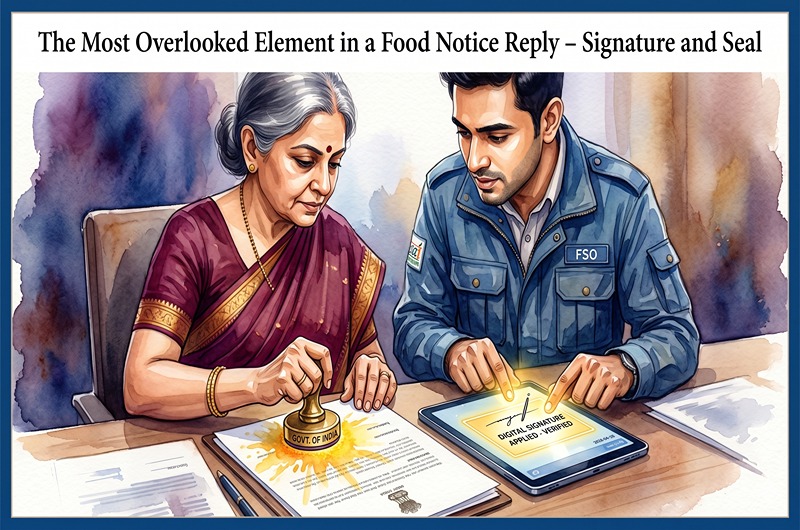
Physical authentication is heavily emphasized in The Most Overlooked Element in a Food Notice Reply – Signature and Seal. The role of the official corporate seal on the FSSAI Food Notice Reply is to authenticate that the correspondence is an official act of the registered company, not just an individual's personal letter. This impacts bureaucratic processing by adding a necessary layer of formal corporate verification to the submitted evidence. Affixing the corporate seal helps business operators secure the overarching quality of products by formally binding the entire corporate entity to the lab reports, infrastructural upgrades, and legal undertakings submitted to the authority. Key stakeholders impacted are the administrative assistants managing company stamps, the authorized signatories, and the FSSAI receiving clerks. Additional insights show that adjudicators are trained to look for the round or rectangular rubber stamp bearing the exact registered company name and location; its absence makes the document appear amateurish and legally weak. Other advice for compiling your Food Notice Reply is to mandate that the corporate seal is stamped directly over or next to the authorized signature on the final page, and that every single attached annexure is also stamped and initialed to prove full corporate endorsement.
Digital Signatures and FoSCoS Portal Uploads
Modernizing the process brings new challenges to The Most Overlooked Element in a Food Notice Reply – Signature and Seal. The role of the FSSAI Food Notice Reply has largely shifted to the FoSCoS digital portal, requiring a blend of physical signatures on scanned documents or verified Digital Signature Certificates (DSC). This impacts the administrative workflow by demanding that traditional corporate authentication methods are successfully adapted for online government portals. Navigating digital signatures helps business operators rapidly defend the quality of products, ensuring their legally binding defense is instantly transmitted to the adjudicator without the delays of physical couriers. Key stakeholders impacted include the IT compliance teams, the executives holding the DSC dongles, and the FSSAI digital infrastructure. Additional insights emphasize that uploading an unsigned Word document converted to a PDF is a fatal error; the portal will accept the upload, but the officer will reject the content. Other advice when finalizing a digital Food Notice Reply is to physically print the final approved draft, physically sign and stamp it, scan it at a high resolution, and then upload that authenticated PDF to the FoSCoS portal to guarantee absolute legal validity.
Establishing Top-Level Management Accountability
The psychological impact of The Most Overlooked Element in a Food Notice Reply – Signature and Seal is establishing trust. The role of a properly signed and sealed FSSAI Food Notice Reply is to signal to the adjudicating officer that the highest echelons of the company are actively engaged in rectifying the food safety hazard. This impacts the regulatory relationship by fostering respect and proving profound corporate accountability. Establishing this top-level accountability helps business operators protect the perceived quality of products, assuring the regulator that safety protocols are funded and enforced from the boardroom down to the factory floor. Key stakeholders impacted are the company's board of directors, the legal liaisons, and the evaluating FSSAI authorities who appreciate executive transparency. Additional insights highlight that officers are significantly more likely to grant leniency if they see the Managing Director's personal signature on an undertaking to improve hygiene. Other advice for your Food Notice Reply is to use the signature block strategically; clearly print the signatory's full name, executive title, and direct contact information below the signature and seal, projecting absolute confidence and a willingness to be held personally accountable for the company's compliance.
Partner with Experts for Flawless Execution
To ensure you never fall victim to The Most Overlooked Element in a Food Notice Reply – Signature and Seal, expert administrative partnership is vital. The role of specialized FSSAI legal consultants in managing your Food Notice Reply is to enforce an ironclad checklist that guarantees every signature, seal, and annexure initialization is flawlessly executed before submission. This impacts the food industry by providing businesses with a foolproof administrative safety net against catastrophic technical rejections. Expert intervention helps business operators focus on culinary innovation and the quality of products while seasoned professionals manage the rigid bureaucratic formatting required by Indian law. Key stakeholders impacted include the fully insulated corporate directors, the meticulous compliance auditing team, and the regulatory authorities who receive perfectly authenticated, legally unassailable files. Additional insights emphasize that the most brilliant scientific defense in the world is useless if a clerk forgets to stamp the paper. Our ultimate advice to operators facing FSSAI scrutiny is to entrust the final compilation to our expert Food Notice Reply service; we ensure your document is legally signed, sealed, and delivered with absolute perfection.