Escalation from Warning to Suspension
Analyzing The Legal Consequences of a Weak Food Notice Reply begins with the terrifying reality of administrative escalation. The role of the initial FSSAI Food Notice Reply is to immediately halt government action, but a weak, poorly documented reply achieves the exact opposite. This deeply impacts the Indian Food Notice Reply landscape by showing that authorities interpret a low-effort defense as proof of a low-effort safety culture. Escalation severely damages a business operator's ability to maintain the quality of products, as it transforms a simple 15-day Improvement Notice into a devastating Show-Cause Notice threatening immediate license suspension. Key stakeholders impacted include the panicked factory managers, the completely blindsided corporate executives, and the FSSAI officers forced to take punitive action. Additional insights emphasize that adjudicators are legally bound to escalate cases if the respondent fails to provide hard, scientific proof of compliance. Other advice to operators drafting a Food Notice Reply is to never underestimate the regulator. Treat even the most mundane labeling query as a high-stakes legal battle; an airtight initial response is the only way to prevent the bureaucratic machinery from grinding your operations to a sudden, catastrophic halt.
The Financial Burden of Maximum Penalties
Financial devastation is a core component of The Legal Consequences of a Weak Food Notice Reply. The role of a robust FSSAI Food Notice Reply is to negotiate down or eliminate proposed administrative fines; a weak reply forfeits this leverage entirely. This impacts the financial stability of the food industry by subjecting non-compliant operators to the maximum penalties allowed under the Food Safety and Standards Act, which can run into lakhs of rupees per violation. Suffering these penalties completely undermines the capital required to improve the quality of products, draining funds that should be spent on better ingredients or hygiene infrastructure directly into government coffers. Key stakeholders impacted are the chief financial officers, venture capital investors, and the adjudicating authorities levying the fines. Additional insights reveal that if a business replies with a generic apology rather than NABL-accredited proof of compliance, the officer has no legal justification to reduce the fine. Other advice when submitting a Food Notice Reply is to view the cost of expert legal drafting not as an expense, but as a crucial financial investment that shields your business's cash flow from massive, avoidable regulatory taxation.
Accidental Admissions of Gross Negligence
Self-sabotage characterizes The Legal Consequences of a Weak Food Notice Reply. The role of the FSSAI Food Notice Reply is to defend the business objectively, but amateur drafting often leads to disastrous, legally binding admissions of fault. This impacts corporate crisis management by handing government prosecutors signed confessions on company letterhead. Making these accidental admissions destroys a business operator's ability to protect the long-term quality of products, as they can legally bind themselves to restrictive, punishing operational mandates forced by the tribunal upon a guilty plea. Key stakeholders impacted include the company directors facing personal criminal liability, the specialized defense attorneys hired later to clean up the mess, and the appellate judges. Additional insights emphasize that trying to be transparent by writing "Our supervisor forgot to check the expiration dates" is a direct confession to misbranding and selling unsafe food. Other advice for your Food Notice Reply is to strictly utilize passive, factual language. A weak reply is one driven by emotion or panic; a strong reply is clinically sanitized to ensure absolutely zero unnecessary legal liability is assumed by the brand.
Ex-Parte Judgments Due to Inadequate Defense
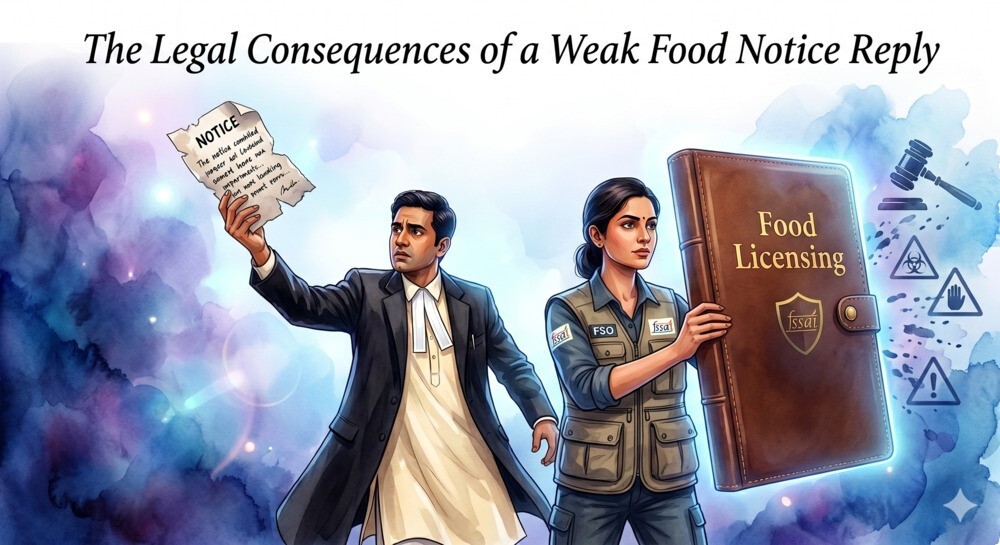
The silent killer among The Legal Consequences of a Weak Food Notice Reply is the ex-parte judgment. The role of the FSSAI Food Notice Reply is to secure your voice in the legal proceedings; submitting a reply that misses the statutory deadline, lacks the correct FSSAI format, or is rejected by the FoSCoS portal effectively silences you. This impacts the legal standing of the business, allowing the adjudicating officer to rule against the company based solely on the inspector's initial report, without any defense considered. Suffering an ex-parte judgment violently halts a business operator's ability to distribute the quality of products, usually resulting in automatic license cancellation and product seizures. Key stakeholders impacted are the massive national workforce, logistics partners, and the authorities passing the default judgments. Additional insights highlight that "we sent it by post but it arrived late" is not a valid legal defense in the digital era; if the portal is locked, you lose. Other advice regarding a critical Food Notice Reply is to ensure flawless administrative execution. A brilliant defense is totally worthless if it is rejected on a technicality; you must strictly manage digital deadlines and formatting rules.
The Long-Term Stigma on Corporate Records
Permanent reputational damage is a lasting factor in The Legal Consequences of a Weak Food Notice Reply. The role of the FSSAI Food Notice Reply is permanently logged in the authority's digital database; a weak, evasive reply creates a historical record of incompetence that haunts the business for years. This impacts the food business environment by ensuring that chronic offenders face increasingly harsh penalties and unannounced raids for even minor future infractions. A negative regulatory record heavily damages the brand's ability to guarantee the quality of products, as regulators will no longer give them the benefit of the doubt during routine audits. Key stakeholders impacted are the future compliance officers inheriting the messy file, brand ambassadors, and the FSSAI appellate tribunal reviewing the company's history. Additional insights emphasize that a history of weak, disorganized replies practically forces the adjudicator to suspend the license to finally enforce compliance. Other advice post-Food Notice Reply is to treat every piece of correspondence as a permanent building block of your corporate reputation; only submit flawless, highly professional documentation that proves your long-term commitment to safety.
Impact on Supply Chain and B2B Contracts
Commercial isolation is a devastating reality detailed in The Legal Consequences of a Weak Food Notice Reply. The role of a successful FSSAI Food Notice Reply is to quickly generate a formal closure report that can be presented to nervous supply chain partners; a weak reply leaves the case open indefinitely. This impacts the broader food economy by triggering domino-effect contract cancellations, as massive retail aggregators refuse to stock products from manufacturers with unresolved regulatory threats. Experiencing this commercial isolation ruins business operators' ability to maintain the consistent distribution and quality of products, cutting off vital cash flow and market presence. Key stakeholders impacted include major retail distributors, ingredient suppliers, and the brand's B2B sales directors. Additional insights emphasize that modern retail giants frequently audit their suppliers' FoSCoS records; an open, poorly handled notice can result in your product being instantly delisted from national supermarket shelves. Other advice when executing a Food Notice Reply is to utilize a rapid, expert strategy to secure a formal closure report immediately, serving as the ultimate proof of corporate competence required to maintain your lucrative B2B contracts.
Partner with Experts to Prevent Legal Disasters
To absolutely avoid The Legal Consequences of a Weak Food Notice Reply, partnering with legal and compliance experts is non-negotiable. The role of specialized FSSAI legal consultants in drafting your Food Notice Reply is to instantly recognize the traps that lead to escalation, fines, and ex-parte judgments, engineering a response that guarantees survival. This impacts the food industry by providing vulnerable businesses with the sophisticated legal shields necessary to fight aggressive regulatory audits. Expert intervention helps business operators focus entirely on maintaining the quality of products while seasoned professionals handle the high-stakes legal maneuvering and digital filing logistics. Key stakeholders impacted include the legally safeguarded business owners, the expert FSSAI consultants, and the regulatory authorities who appreciate compliant, thorough submissions. Additional insights highlight that the cost of an expert reply is infinitely smaller than the catastrophic financial losses of a suspended food license and a sealed factory. Our definitive advice to any operator facing FSSAI scrutiny is to never risk a weak, DIY response. Engage our expert Food Notice Reply service immediately to ensure your license remains active and your business is completely protected.