The 2026 Visual Language of Dietary Choice
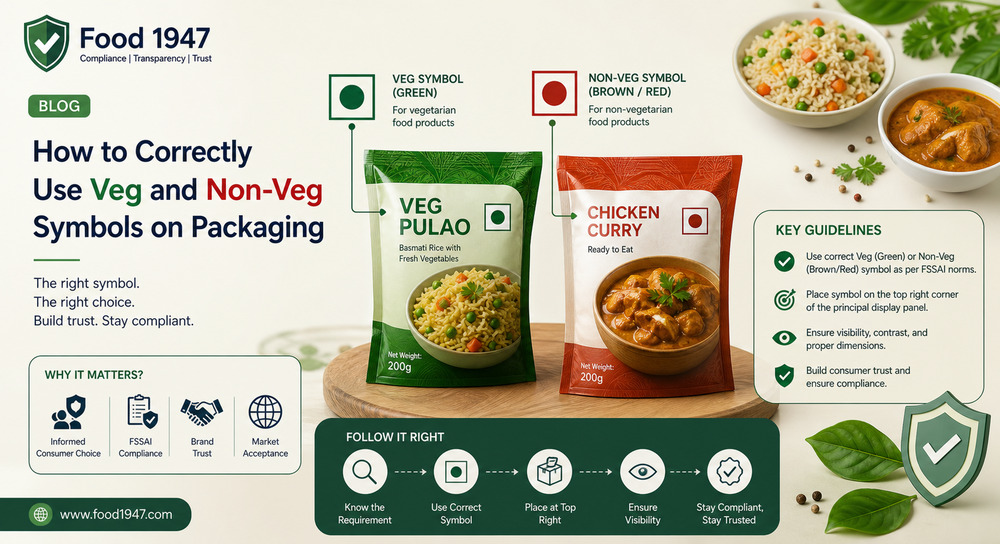
In 2026, the Veg and Non-Veg symbols are the most recognized icons on the Indian food label, serving as a primary filter for millions of consumers. This impacts the industry by making the "Declaration of Origin" a foundational element of packaging design. FSSAI’s role is to standardize these symbols—the green circle for Veg and the brown triangle (updated in recent years for color-blind accessibility) for Non-Veg—to ensure they are universally understood. This serves the public by allowing for instant dietary identification without reading a word of text. The industry helps business operators by providing the exact vector graphics and color codes (Hex codes) required for these symbols. Key stakeholders include branding agencies, printing experts, and consumer rights groups. Compliance in 2026 is non-negotiable; even a minor deviation in the symbol’s shape or color can lead to "Misbranding" charges. Industry advice is to treat these symbols with the same importance as the brand logo, as they are the first thing a consumer looks for. Correct usage is the hallmark of a transparent and consumer-centric food business.
Technical Specifications: Shape, Size, and Color Standards
Under the 2026 FSSAI Labelling and Display regulations, the technical specs for Veg and Non-Veg symbols are precisely defined. This impacts the industry by requiring a "Design Audit" for every SKU to ensure the symbol is proportionate to the pack size. FSSAI’s role is to protect the public from "ambiguous" symbols that may hide the true nature of the ingredients. The industry helps business operators by providing "Symbol Sizing Charts" based on the principal display panel (PDP) area. Key stakeholders include quality assurance teams and packaging engineers. For example, if the area of the PDP is up to 100 $cm^2$, the minimum diameter of the green circle must be 3 mm, with a square frame of 6 mm. An additional insight for 2026 is the strict requirement for the "Brown Triangle" for non-veg items, which replaced the old brown circle to better assist those with color vision deficiency. Industry advice is to always use a high-contrast background to ensure the symbol "pops" against the packaging. Compliance with these technical details is a primary checklist item for FSSAI enforcement officers.
Placement and Proximity: Where the Symbol Must Sit
The 2026 guidelines are very specific about where these symbols must be placed on the package. This impacts the industry by centralizing the layout of the front-of-pack. FSSAI’s role is to ensure the public can find the symbol near the brand name or the name of the food, making the identification process seamless. The industry helps business operators by providing "Safe Zone" templates for label layout. Key stakeholders include UI/UX designers for e-commerce and retail designers. An additional insight for 2026 is that the symbol must not be obscured by folds, crinkles, or the FSSAI logo. Industry advice is to place the symbol in the top-left or top-right corner of the principal display panel to align with natural scanning patterns. Compliance in placement ensures that the consumer is never "deceived" by a hidden or hard-to-find dietary marker. In 2026, the location of the symbol is as important as the symbol itself.
The "Egg-Containing" Dilemma and Non-Veg Classification
A common area of confusion in 2026 is the classification of products containing eggs. Under FSSAI law, any product containing egg is classified as "Non-Veg" and must carry the brown triangle symbol. This impacts the Indian food industry, particularly the bakery and supplement sectors, where "Veg-labeled" egg products are a major compliance risk. FSSAI’s role is to maintain the dietary integrity of the symbols for the public, ensuring that vegetarians are not misled. The industry helps business operators by providing "Ingredient Screening" services to detect hidden egg-derived additives like lecithin or albumin. Key stakeholders include product formulators and regulatory auditors. An additional insight for 2026 is that honey, though animal-derived, is classified as "Veg," providing a specific exemption that operators must understand. Industry advice is to clearly state "Contains Egg" in the allergen declaration alongside the brown triangle. Compliance in this nuanced area is vital for building a brand that is respected by India’s large vegetarian population.
Exemptions and Special Cases in 2026 FSSAI Rules
Not all products are required to carry the Veg/Non-Veg symbols in 2026, and understanding these exemptions can save space on the label. This impacts the industry by allowing for cleaner designs on specific items like mineral water, salt, and carbonated beverages (if they are purely sugar-based). FSSAI’s role is to provide a clear "Exemption List" to prevent unnecessary labeling. The industry helps business operators by identifying which products in their portfolio can skip the symbol without risking non-compliance. Key stakeholders include category managers and regulatory consultants. An additional insight for 2026 is that "Additives" and "Processing Aids" do not trigger the symbol if they are present in insignificant amounts, provided the primary ingredients are veg. However, industry advice is: "When in doubt, label it." For high-risk products like nutraceuticals, even if an exemption might apply, displaying the symbol often enhances consumer trust. Compliance means knowing when the symbol is a mandate and when it is a choice.
Enforcement, Consumer Litigation, and the Cost of Error
In 2026, the mislabeling of a Non-Veg product as Veg is one of the fastest ways to face both regulatory penalties and consumer lawsuits. This impacts the industry by making the symbol check a high-stakes "Final Step" in the production process. FSSAI’s role is to act as the ultimate arbiter in cases of dispute, often using DNA testing to verify the presence of animal-derived ingredients. This protects the public from ethical and religious violations. The industry helps business operators by providing "Animal Origin Testing" (AOT) for raw materials. Key stakeholders include legal advisors and lab technicians. An additional insight for 2026 is the rise of "Class Action" suits in India for mislabeled dietary markers. Advice to the food industry is to maintain a "Veg/Non-Veg Certificate" for every single ingredient in the warehouse. Compliance is your only defense against a "Misbranding" charge that can tarnish your brand for years. In the 2026 market, the Veg and Non-Veg symbols are more than just ink—they are a legal and ethical contract with the Indian consumer.
Integrity in Every Symbol: A 2026 Industry Standard
In conclusion, the correct use of Veg and Non-Veg symbols is a fundamental pillar of food safety and transparency in 2026. FSSAI’s precise standards for these icons ensure that the diverse dietary needs and ethical choices of the Indian public are respected and protected. For business operators, compliance is not just about avoiding fines; it is about honoring the trust that consumers place in your brand every time they scan a label. By prioritizing technical accuracy and seeking expert guidance, you can ensure that your dietary markers are a source of brand pride rather than a regulatory liability. In 2026, a compliant symbol is the ultimate sign of a professional, ethical, and successful food business.