The Foundation of Pre-Drafting Triage
Understanding What to Do Before You Write Your Food Notice Reply – Investigation Steps is the absolute bedrock of regulatory survival. The role of the FSSAI Food Notice Reply is to present a flawless legal narrative, but that narrative is impossible to draft without a rigorous, clinical pre-investigation. This impacts the Indian Food Notice Reply process by shifting the corporate reaction from emotional panic to structured, methodical data collection. Conducting this triage helps business operators immediately secure the quality of products by identifying the scope of the alleged violation before taking any blind legal steps. Key stakeholders impacted include the executive board seeking clarity, the facility managers leading the ground audit, and the legal counsel waiting for raw facts. Additional insights emphasize that the most common mistake entrepreneurs make is sitting down to write the reply the moment the notice arrives, resulting in a defensive, factually empty letter. Other advice to operators initiating a Food Notice Reply is to lock away your company letterhead for the first 48 hours; your sole objective during this phase is to become a forensic investigator within your own factory, gathering the undeniable truths that will later form your defense.
Halting Suspect Operations Immediately
The very first tactical maneuver in What to Do Before You Write Your Food Notice Reply – Investigation Steps is physical containment. The role of the impending FSSAI Food Notice Reply will be to prove that public health was protected, which requires an instant operational freeze on the disputed process. This impacts the facility's daily output by prioritizing legal compliance over immediate production targets. Halting suspect operations helps business operators definitively guarantee the safety and quality of products, ensuring that if a machine is cited for contamination, it is powered down and locked out until the investigation clears it. Key stakeholders impacted are the line supervisors executing the halt, the logistics coordinators managing the shortfall, and the FSSAI inspectors monitoring the business's initial reaction. Additional insights reveal that continuing to run a cited production line while drafting your legal defense is viewed by authorities as willful negligence and grounds for immediate license cancellation. Other advice for managing the crisis prior to your Food Notice Reply is to issue a formal, documented "stop-work" order. This internal memo not only contains the physical hazard but also serves as your first crucial piece of documentary evidence proving your commitment to food safety.
Assembling an Internal Crisis Team
Cross-functional coordination defines What to Do Before You Write Your Food Notice Reply – Investigation Steps. The role of the FSSAI Food Notice Reply requires data from multiple departments—legal, quality assurance, maintenance, and HR—necessitating a unified command structure. This impacts corporate crisis management by breaking down departmental silos to focus massive internal resources on a single regulatory threat. Assembling a crisis team helps business operators effectively evaluate the overarching quality of products, combining the technical knowledge of the food scientist with the operational reality of the floor manager. Key stakeholders impacted include the designated crisis team leader, the department heads supplying the data, and the legal counsel guiding the strategy. Additional insights emphasize that a fragmented investigation, where QA doesn't talk to Maintenance, results in a contradictory and legally fatal notice reply. Other advice when organizing your Food Notice Reply strategy is to establish a daily 15-minute briefing with this core team. Assign specific investigative tasks—such as pulling temperature logs or contacting pest control vendors—with strict internal deadlines, ensuring the drafting lawyers receive a comprehensive, cohesive data packet.
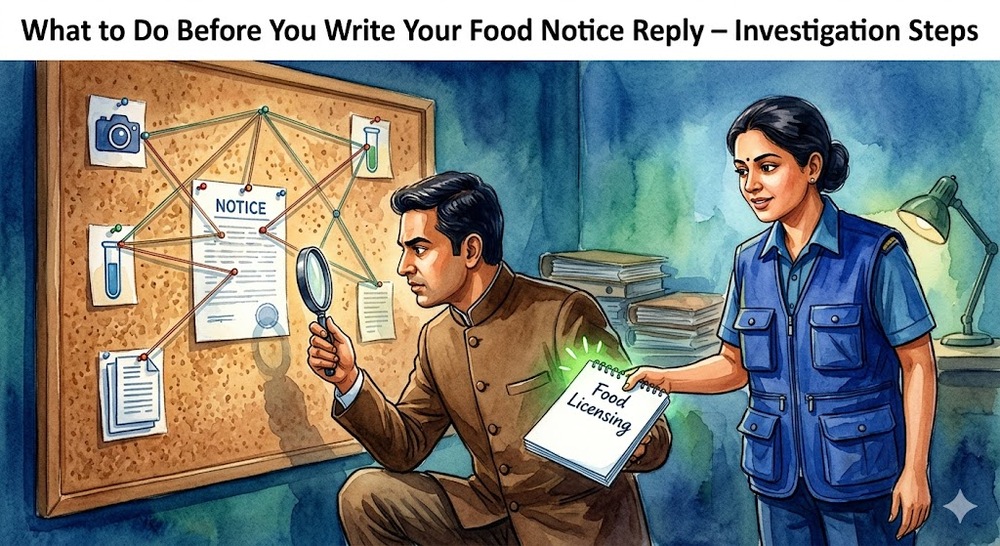
Conducting a Rigorous Root-Cause Analysis
Deep technical auditing is the core of What to Do Before You Write Your Food Notice Reply – Investigation Steps. The role of the finalized FSSAI Food Notice Reply will be to prove the problem is permanently fixed, which is impossible without identifying the exact root cause. This impacts the food processing industry by forcing businesses to look past superficial symptoms and dig into structural or procedural failures. Conducting this rigorous analysis helps business operators permanently restore the quality of products, ensuring that an unapproved additive or a bacterial spike is traced back to a specific faulty valve or a specific negligent vendor. Key stakeholders impacted are the root-cause analysis technicians, the facility engineers, and the FSSAI scientists who demand systemic solutions. Additional insights show that adjudicators easily spot surface-level fixes; if you claim to have cleaned a puddle without fixing the leaking pipe, your reply will be rejected. Other advice for the investigative phase of your Food Notice Reply is to utilize established frameworks like the "5 Whys" or Ishikawa diagrams. Documenting this methodical approach not only finds the true error but provides incredibly persuasive evidence of your sophisticated safety culture.
Gathering Cross-Departmental Documentation
Evidence collection dictates What to Do Before You Write Your Food Notice Reply – Investigation Steps. The role of the FSSAI Food Notice Reply is to be an evidentiary portfolio; your pre-drafting phase must involve gathering every single document related to the cited batch or facility zone. This impacts administrative efficiency by requiring a massive, rapid extraction of digital and physical logs from across the company. Gathering this documentation helps business operators unequivocally validate the quality of products, pulling NABL lab reports, raw material CoAs, FoSTaC training certificates, and Legal Metrology stamps into a single master file. Key stakeholders impacted include the archive clerks, the quality assurance documentation leads, and the legal drafting team reviewing the raw materials. Additional insights emphasize that you must gather more evidence than you plan to submit; having the complete picture allows the legal team to select the most strategic pieces of proof. Other advice preparing for your Food Notice Reply is to organize the gathered documents chronologically and by department in a secure digital folder, providing your legal counsel with a perfectly indexed library from which to build the defense.
Reviewing Historical Compliance Data
Contextualizing the error is a subtle but powerful part of What to Do Before You Write Your Food Notice Reply – Investigation Steps. The role of the FSSAI Food Notice Reply is to frame the current issue as a rare anomaly, which requires reviewing the facility's historical compliance data. This impacts the legal narrative by allowing the business to leverage years of good behavior against a single regulatory allegation. Reviewing this historical data helps business operators defend the long-term perceived quality of products, pulling previous clean FSSAI inspection reports and years of flawless internal audits to prove that the brand operates at a high baseline of safety. Key stakeholders impacted are the long-term compliance officers, the corporate brand directors, and the FSSAI adjudicators reviewing the company's dossier. Additional insights highlight that an officer is significantly more lenient if the investigation proves the business has an otherwise spotless regulatory record. Other advice for your Food Notice Reply preparation is to actively search your archives for any past interaction with the specific inspector or department; understanding their historical focus helps tailor the tone and precision of your upcoming legal defense.
Partner with Experts for Strategic Investigations
To flawlessly execute What to Do Before You Write Your Food Notice Reply – Investigation Steps, expert oversight is highly recommended. The role of specialized FSSAI legal consultants during this pre-drafting phase is to direct the internal investigation, telling the business exactly where to look and what data to secure to build the strongest possible legal argument. This impacts the industry by providing businesses with seasoned regulatory detectives who know exactly how adjudicators think. Expert intervention helps business operators focus on maintaining the quality of products while professionals orchestrate the rapid, highly targeted data extraction required for victory. Key stakeholders impacted include the legally insulated business owners, the expert compliance investigative team, and the regulatory authorities who ultimately receive a perfectly researched submission. Additional insights emphasize that businesses often waste precious days investigating the wrong parameters; an expert instantly narrows the focus to the legally relevant facts. Our ultimate advice to operators facing FSSAI scrutiny is to partner with our expert Food Notice Reply service on day one; we guide your internal investigation step-by-step, ensuring you gather the exact evidence needed to craft an impenetrable legal defense.