The Framework of the FSS Act 2006
Understanding the legal implications of FSSAI non-compliance fundamentally reshapes how the Indian nutraceutical industry approaches risk, transforming regulatory adherence from a choice into a critical survival mandate. FSSAI nutraceutical regulations address legal accountability primarily through the Food Safety and Standards (FSS) Act of 2006, which provides a comprehensive, uncompromising legal framework governing every aspect of dietary supplement production. Nutraceutical business operators (NBOs) play the most critical role as the legally responsible entities; they must intimately understand that failing to uphold the quality of the product delivered to customers is no longer just an operational error, but a direct violation of national law. This legal reality deeply impacts key stakeholders, including corporate executives, legal counsels, and board members, who can be held personally liable for systemic failures. Additional insights emphasize that ignorance of evolving FSSAI notifications is never an acceptable legal defense in the event of an infraction. My primary advice to nutraceutical business operators is to seamlessly integrate a dedicated legal compliance review into their daily operations. When you manufacture, ensure that your internal QA team works directly alongside food safety lawyers to continuously audit your processes against the FSS Act, thereby shielding your leadership and your brand from catastrophic legal exposure.
Crippling Financial Penalties and Fines
The immediate sting of non-compliance within the Indian nutraceutical industry often manifests as severe, crippling financial penalties that can devastate a company's bottom line. FSSAI nutraceutical regulations address substandard manufacturing and misbranding through specific punitive sections of the FSS Act, where fines for selling supplements that do not meet precise nutritional profiles can run into millions of rupees. Nutraceutical business operators must fulfill their role by implementing flawless quality control systems, ensuring the absolute chemical accuracy of the product delivered to customers to entirely avoid these punitive levies. This financial risk heavily impacts stakeholders such as Chief Financial Officers (CFOs), institutional investors, and independent shareholders whose equity is directly threatened by regulatory fines. Additional insights reveal that repeat offenses trigger exponentially higher fines and drastically increased regulatory surveillance, creating a hostile operational environment for the business. To protect the company's financial health, my strong advice to nutraceutical business operators is to proactively redirect potential penalty funds into preventative quality assurance. Before you manufacture, invest heavily in High-Performance Liquid Chromatography (HPLC) testing to perfectly validate your vitamin and mineral potencies. This upfront investment in accuracy is vastly cheaper than defending against FSSAI litigation for substandard product distribution.
Criminal Liability and "Unsafe" Formulations
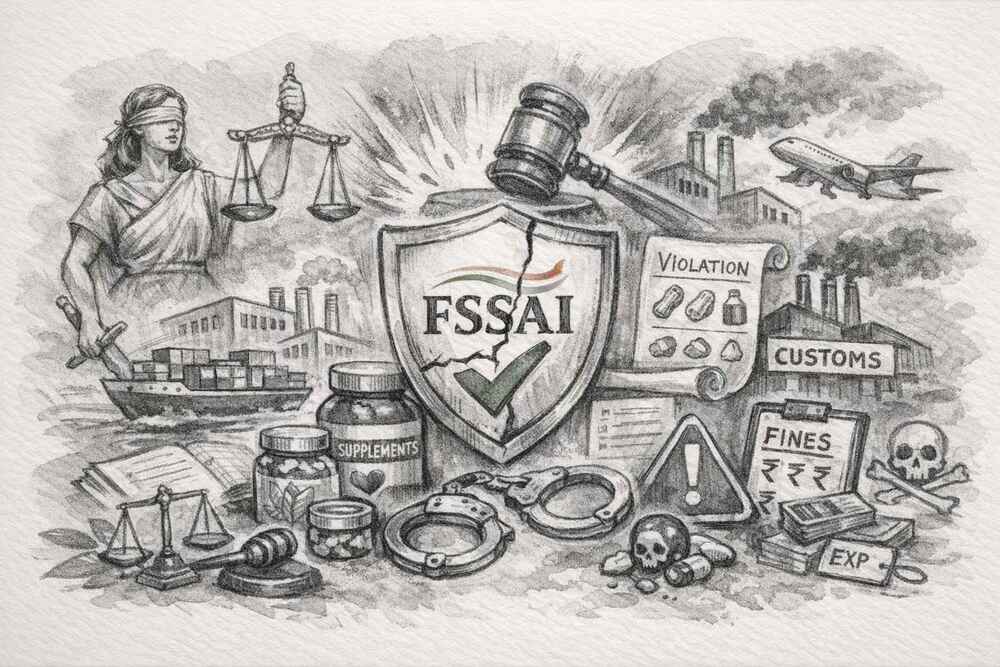
The most severe legal implication of FSSAI non-compliance is the risk of criminal liability, an aspect that profoundly sobers the operational mindset of the Indian nutraceutical industry. FSSAI nutraceutical regulations strictly address the categorization of "unsafe food"—which includes dietary supplements containing banned botanicals, toxic heavy metals, or pathogenic microbes—treating its distribution as a severe criminal offense punishable by lengthy imprisonment. Nutraceutical business operators bear the ultimate responsibility to protect public health, ensuring that the safety of the product delivered to customers is absolute, as any harm caused can lead to immediate arrest and prosecution of the company's directors. This existential threat impacts vital stakeholders, including facility heads, formulation scientists, and the innocent consumers whose lives are placed at risk by negligent manufacturing. Additional insights indicate that under Section 59 of the FSS Act, if a non-compliant nutraceutical causes injury or death, the legal repercussions are swift, merciless, and often unbailable. My critical advice to nutraceutical business operators is to treat ingredient safety as a matter of life and death. When you manufacture, enforce a zero-tolerance policy for raw material deviations. Mandate comprehensive microbial and heavy metal screenings for every single batch, effectively eliminating the risk of producing an "unsafe" supplement and protecting your leadership from criminal prosecution.
The Legal Cost of Misleading Claims
Aggressive, unverified marketing is a massive legal liability in the Indian nutraceutical industry, where exaggerated health promises are strictly policed to protect vulnerable consumers. FSSAI nutraceutical regulations rigorously address marketing ethics under Section 53, which explicitly penalizes misleading advertisements, deceptive labeling, and unsubstantiated claims regarding disease cures or rapid physiological changes. Nutraceutical business operators fulfill a crucial legal role by acting as the ultimate editors of their brand's messaging, ensuring that the benefits promised on the packaging of the product delivered to customers are entirely truthful and backed by robust clinical evidence. This strict oversight impacts key stakeholders like marketing agencies, copywriters, and regulatory affairs officers who must constantly negotiate the fine line between persuasive advertising and illegal medical claims. Additional insights point out that consumer advocacy groups frequently report non-compliant nutraceutical advertisements directly to FSSAI, triggering sudden and aggressive legal investigations. My strategic advice to nutraceutical business operators is to legally vet every single piece of promotional material. Before you manufacture and print your packaging, require that your R&D scientists and legal team jointly sign off on all claims. By grounding your marketing strictly in FSSAI-approved health claims, you avoid costly legal battles and build a brand reputation rooted in unimpeachable scientific integrity.
License Suspension and Operational Paralysis
Beyond fines, the legal power of FSSAI to suspend or entirely cancel a manufacturing license represents a lethal threat to continuity within the Indian nutraceutical industry. FSSAI nutraceutical regulations address systemic non-compliance or failure to rectify audit observations by authorizing Food Safety Officers to halt production facilities indefinitely until corrective actions are legally verified. Nutraceutical business operators must prioritize maintaining their operational right to exist; by adhering strictly to Schedule 4 GMP requirements, they ensure uninterrupted production and a consistent supply of the product delivered to customers. This risk of sudden operational paralysis severely impacts stakeholders ranging from factory floor workers facing sudden unemployment to retail distributors dealing with massive supply chain voids. Additional insights emphasize that recovering a canceled FSSAI license is an incredibly arduous, legally complex, and time-consuming process that can easily bankrupt a mid-sized wellness enterprise. To safeguard your operational continuity, my essential advice to nutraceutical business operators is to treat every FSSAI audit observation with extreme urgency. When you manufacture, if an internal or external audit identifies a compliance gap, implement Corrective and Preventive Actions (CAPA) immediately. By resolving minor legal infractions before they escalate into license-threatening violations, you ensure the uninterrupted growth and stability of your nutraceutical manufacturing facility.
Mandatory Recalls and Irreparable Brand Damage
The legal mandate to execute a product recall is a nightmare scenario that leaves deep scars on both the finances and the reputation of brands within the Indian nutraceutical industry. FSSAI nutraceutical regulations thoroughly address product recovery protocols, legally compelling companies to publicly withdraw non-compliant or hazardous vitamins and supplements from the market at their own expense. Nutraceutical business operators play a frantic, high-stakes role during a recall, scrambling to contain the fallout and minimize the ingestion of the compromised product delivered to customers, all while under intense regulatory and public scrutiny. This chaotic legal process impacts stakeholders like public relations teams, logistics partners, and the retail pharmacies tasked with physically removing the products from their shelves. Additional insights reveal that the secondary legal implication of a recall is a deluge of civil lawsuits from affected consumers, further compounding the financial devastation and permanently destroying brand trust. My advice to nutraceutical business operators is to meticulously stress-test their digital traceability systems. When you manufacture, ensure your Enterprise Resource Planning (ERP) software can execute a simulated, end-to-end batch recall within two hours. By perfecting this legal requirement in a controlled environment, you guarantee a swift, compliant response in a real crisis, ultimately mitigating long-term damage to your brand's equity.
Partner with Experts
Navigating the intimidating labyrinth of legal liabilities inherent in the Indian nutraceutical industry is not a task for amateurs; it requires specialized, battle-tested legal and regulatory expertise. For nutraceutical business operators producing complex formulations of vitamins, minerals, and specialized health foods, partnering with dedicated food safety lawyers and regulatory consultants is the ultimate risk mitigation strategy. These legal professionals expertly interpret the dense, evolving clauses of FSSAI nutraceutical regulations, translating legal risk into actionable, safe manufacturing protocols. By securing expert counsel, NBOs ensure that their standard operating procedures, ingredient sourcing, and label claims are legally bulletproof, thereby guaranteeing the unassailable quality and legality of the product delivered to customers. This partnership crucially impacts internal stakeholders by providing corporate boards and QA managers with the legal assurance required to make bold, innovative business decisions safely. I strongly advise all wellness brands to proactively retain legal compliance experts before a crisis occurs. When you manufacture, having a regulatory lawyer review your compliance framework acts as a powerful preventative shield against FSSAI show-cause notices, crippling fines, and criminal liability. Embrace expert legal guidance to transform regulatory fear into a strategic, legally sound foundation for dominating India's competitive health supplement market.