Decoding the Licensing Labyrinth
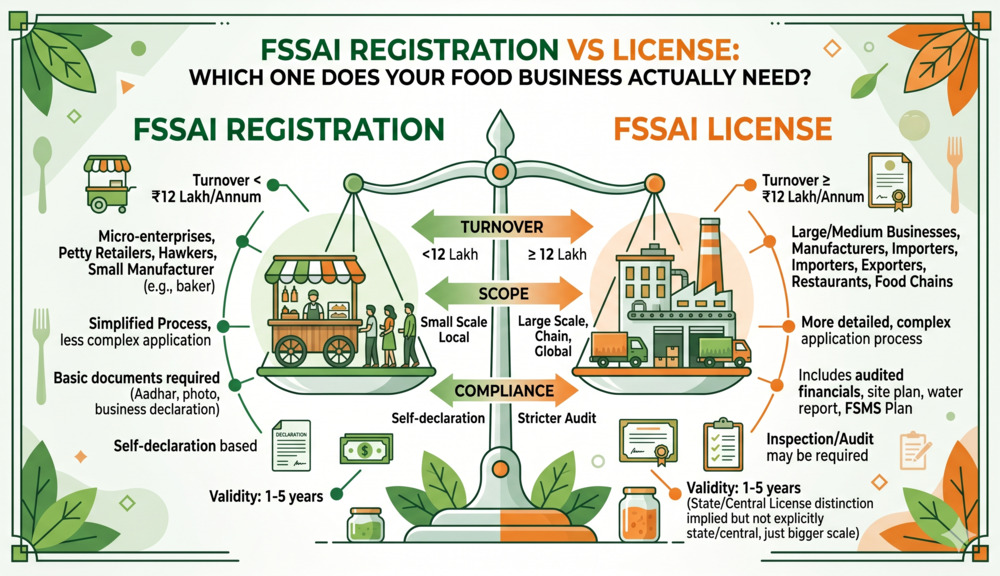
Stepping into the Indian food and nutraceutical sector requires successfully navigating a dense bureaucratic labyrinth, starting with the most fundamental question: FSSAI Registration vs License: Which One Does Your Food Business Actually Need? The Food Safety and Standards Authority of India (FSSAI) does not issue a one-size-fits-all permit. Instead, it operates a strict, three-tiered system designed to scale regulatory oversight proportionately with the size and operational risk of a business. Misunderstanding this critical distinction is the first, and often most expensive, mistake a new entrepreneur can make. Applying for a basic registration when your product line legally mandates a central license will result in immediate application rejection, forfeited fees, and months of catastrophic delays to your market launch. Conversely, over-applying for a complex central license when you only need a state permit creates unnecessary compliance burdens and administrative bloat. Achieving absolute clarity on your required tier based on exact legal parameters is the foundational step to ensuring legal, uninterrupted commercial operations.
The Parameters of Basic Registration
The lowest tier of the FSSAI system is the Basic Registration, designed exclusively to regulate micro-enterprises and petty food business operators. Legally, this tier is strictly limited to businesses with an annual turnover of less than twelve lakh rupees. It applies to small-scale entities such as local home bakers, tiny street food vendors, and minor retail shops that do not engage in complex manufacturing. The compliance burden for Basic Registration is intentionally light, requiring minimal documentation and a simplified online application through the FoSCoS portal. However, for ambitious startups planning to scale rapidly, secure distributor networks, or list their products on major e-commerce platforms like Amazon or Flipkart, a Basic Registration is severely inadequate. Major logistics partners and corporate retailers categorically refuse to onboard vendors holding only a basic registration, recognizing that it does not mandate the rigorous hygiene and safety audits required to protect modern consumers.
Thresholds for the State License
The moment your food business scales beyond the twelve-lakh-rupee annual turnover mark, or if your daily production capacity expands significantly, FSSAI regulations legally mandate an upgrade to a State License. This middle tier encompasses the vast majority of mid-sized manufacturers, regional distributors, large restaurants, and standard food processing units operating within the borders of a single Indian state. The application process for a State License is drastically more rigorous than Basic Registration. You must submit comprehensive facility blueprints, detailed machinery lists, and a robust Food Safety Management System (FSMS) plan based on HACCP principles. State licensing authorities will heavily scrutinize your hygiene protocols and traceability matrices. Holding an active State License unlocks significant commercial opportunities, providing the legal credibility required to partner with regional supermarket chains, secure larger manufacturing contracts, and establish a dominant retail presence across your operating state without regulatory interference.
Mandates for the Central License
The pinnacle of FSSAI regulatory compliance is the Central License, administered directly from the authority's headquarters in New Delhi. This tier is mandatory for high-stakes, large-scale operations, regardless of their initial turnover. If you are manufacturing specialized nutraceuticals, health supplements, or proprietary foods, you must acquire a Central License due to the complex scientific scrutiny required for these products. Furthermore, businesses operating in multiple states, 100% export-oriented units, large-scale importers of food items, and massive production facilities exceeding strict daily metric ton capacities fall automatically under central jurisdiction. The Central License application demands exhaustive documentation, including NABL-accredited laboratory test reports, rigorous product formulation dossiers, and immaculate import/export clearances. Attempting to bypass the Central License when dealing in supplements or national distribution is a severe criminal offense, triggering aggressive crackdowns, immediate operational shutdowns, and massive financial penalties.
The Critical Process of License Upgrading
A highly vulnerable period for growing food businesses occurs during the transition between licensing tiers. FSSAI authorities strictly monitor the declared turnover and production capacities associated with your current license. If your regional snack brand experiences explosive growth and your revenue crosses the State License threshold into Central License territory (typically over twenty crore rupees annually), you are legally obligated to proactively upgrade your license status before you hit that financial mark. Operating a massive manufacturing facility on a basic registration or a small state license is a massive compliance violation. The upgrade process involves submitting new applications, paying higher government fees, and satisfying vastly more stringent FSMS requirements. Failing to anticipate this growth and navigate the upgrade process seamlessly leaves your business legally exposed. Diligent monitoring of your operational metrics ensures your license tier always reflects your commercial reality.
The High Cost of Misclassification
Attempting to decipher the convoluted FSSAI licensing tiers without specialized expertise introduces an astronomical level of risk that can cripple a business before it even launches. The complexity of regulatory classification is a formidable barrier; rules regarding specific food categories, capacity calculations, and proprietary formulations are highly technical and strictly enforced. An innocent misclassification of your required license inevitably leads to catastrophic, costly mistakes. Submitting the wrong application results in immediate rejection, forcing you to forfeit government fees and suffer months of paralyzed operations while you restart the process. Manufacturing products without the correct legal tier exposes you to severe financial penalties running into lakhs of rupees, immediate product confiscation, and public relations nightmares. The financial bleeding caused by a stalled product launch far outweighs any initial savings gained by attempting a difficult DIY approach to licensing. Independent compliance is a dangerous gamble you cannot afford.
Partner with Food 1947 for Perfect Licensing
Securing the exact, correct FSSAI license for your unique business model requires elite regulatory insight and precise bureaucratic maneuvering. Do not risk your commercial launch, face devastating penalties, or suffer months of delays by guessing your required license tier. Partner with Food 1947 to guarantee your licensing strategy is absolutely flawless. Our expert regulatory consultants conduct a microscopic analysis of your turnover projections, product formulations, and manufacturing capacities to pinpoint your exact legal requirements. We manage the entire end-to-end application process through the FoSCoS portal—from drafting rigorous FSMS plans for Central Licenses to expediting State License approvals. We eliminate the immense stress of bureaucratic rejection, ensuring your business enters the market legally, swiftly, and safely. Contact Food 1947 today for a comprehensive licensing consultation, and let our seasoned experts secure the definitive legal foundation for your commercial success.